
2026 whale survey records 100 more calves despite slowing calving rates
Wednesday, 7 October 2026
Ishmael Mabena | 7 Oct 2026
South Africa’s southern right whale population is continuing to grow. However, climate-related changes in the Southern Ocean are slowing the rate at which females reproduce.
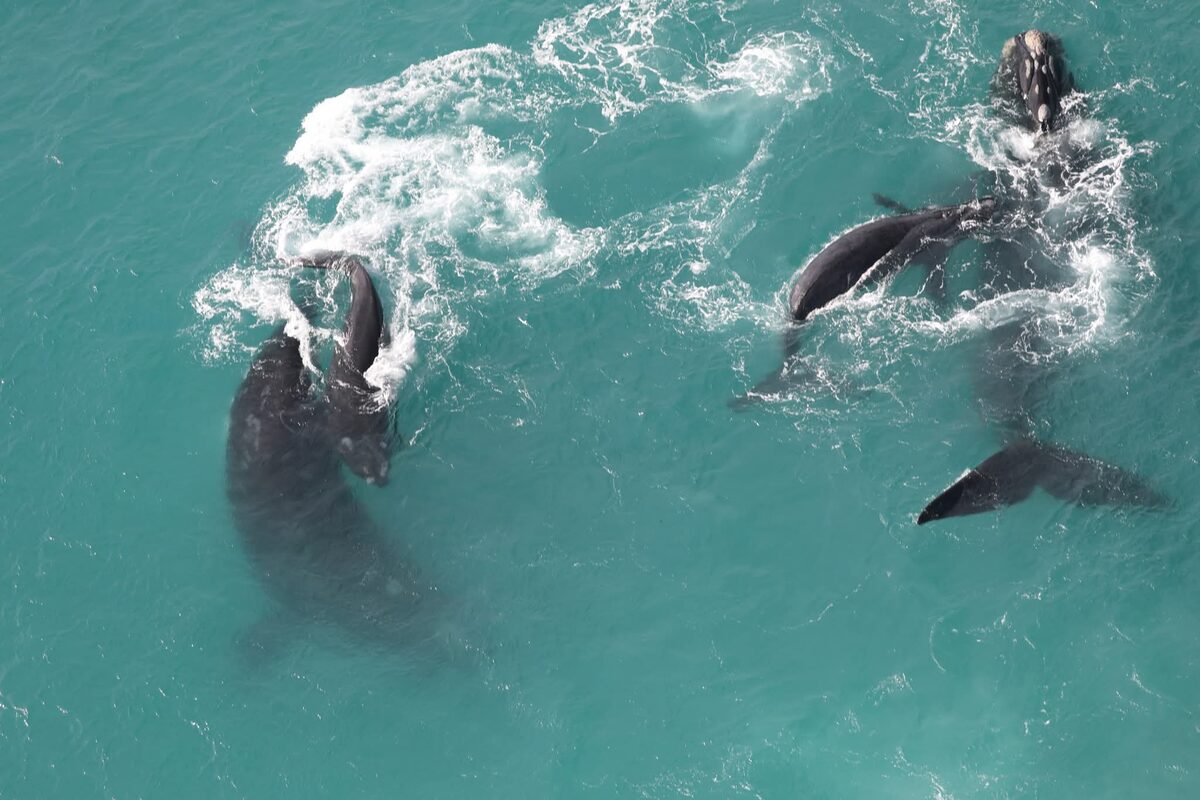
The results come as the Mammal Research Institute (MRI) Whale Unit completed its 2026 annual aerial survey of southern right whales along the country’s coastline.
Recording 222 cow-calf pairs and 25 unaccompanied adults. This is 100 more calves in comparison to 2025.
Forming part of a nearly six-decade-long monitoring programme the survey tracks one of South Africa’s most iconic marine species.
While the 2026 figures represent a significant increase in calves compared to last year (about 100 more calves), researchers caution that annual fluctuations in the number of whales seen along the coast should not be interpreted in isolation.
Slower than previously estimated
Prof Els Vermeulen of the MRI Whale Unit said the southern right whale population remains on a long-term upward trajectory. It is increasing by about 6,5% a year.
That rate is, however, slower than the previously estimated annual growth rate of about 7%.
“The population increases at about 6,5% per year,” Vermeulen said.
She explained that coastal presence is closely linked to calving. This is because females generally come to South African waters when they are pregnant and ready to give birth.
Changing reproductive cycle is therefore central to understanding the annual survey results.
According to Vermeulen, southern right whale females historically reproduced roughly every three years, close to the maximum biologically possible interval.
But that interval has lengthened considerably.
By 2022 the average recorded calving interval had reached seven years. Researchers have documented an increase in the interval since around 2009 and 2010.
Vermeulen cautioned, however, that intervals longer than six years are difficult to interpret. This is because researchers cannot always determine whether a female genuinely went several years without reproducing or whether she gave birth but was not detected during the survey.
The longer reproductive intervals have not yet translated into a population decline.
“The number of calves is considered healthy,” Vermeulen said, adding that once calves are born, their chances of survival are relatively high and the population is still estimated to be increasing in the long term.
Migratory capital breeders
But the slowdown in reproduction has prompted researchers to investigate what is happening in the whales’ feeding grounds in the Southern Ocean.
Southern right whales are migratory “capital breeders”.
This means they must build up sufficient energy reserves while feeding before returning to South African coastal waters, where they give birth and nurse their calves.
If feeding conditions deteriorate, females may not accumulate enough energy to reproduce at their previous rate.
Researchers have been monitoring environmental conditions in Antarctic waters where the whales feed.
Vermeulen said some results have shown reductions in sea ice in areas traditionally used by the whales to find sufficient food.
Changes in sea-ice conditions may affect prey availability and force whales to alter their feeding behaviour. They may potentially move into the south-western Atlantic.
Alternatively, they remain around oceanographic frontal systems such as the tropical and polar fronts, where different prey species may be available.
The researchers are examining a range of environmental factors, including sea-ice conditions, water temperatures and mixed-layer depths.
All these factors contribute to the oceanographic conditions that determine whether suitable feeding habitat is available.
Moreover, there is also evidence that the whales themselves are showing the effects of changing conditions.
Traveling further distances for food
Females are approximately 23% thinner than females were in the 1980s. This suggests that their energy intake or net energy gain is no longer the same.
However, that does not necessarily mean the whales cannot find food. It simply means that they may have to travel further to obtain sufficient food, expending more energy in the process.
“There is a link between slower calving rates and females getting 23% thinner than what they were in the 1980s,” Vermeulen said. “Climate change is affecting reproduction.”
The relationship is important because the whales do not always feed while they are on the South African coast. They rely on the energy accumulated during their feeding period to sustain reproduction.
Whales that are not heavily pregnant or do not have sufficient energy reserves may therefore remain offshore. They remain there rather than migrating to the coast.
Their absence from the annual coastal survey does not necessarily mean they have disappeared from the population.
2026’s survey also found that most cow-calf pairs were concentrated in De Hoop, Struisbaai and Walker Bay. These are areas that have served as important southern right whale nursery areas for decades.
Vermeulen said these remain the three principal regions where large numbers of whales are present and calves are born. This distribution has remained broadly consistent over the past four decades.
What makes the annual count valuable
For researchers, that long-term consistency – combined with decades of individual whale histories, aerial surveys and environmental data – is what makes the annual count valuable.
Therefore, the 2026 result presents a mixed picture.
More calves than last year and a southern right whale population that continues to grow. But a reproductive cycle that has slowed dramatically and is increasingly being examined against changes in the whales’ Southern Ocean feeding environment.
Meanwhile, industry colleagues “recognise the immense value of the survey as well as the effort that goes into it”, said Dr Loraine Shuttleworth of the Dyer Island Conservation Trust.
The annual count provides a snapshot. The nearly six decades of monitoring provide the bigger picture.